
GTA’s identity is in its verbs, not just its look
Maps, mods, and collectibles show what fans can copy—and the systemic challenge GTA 6 still has to meet.
Redação G6 World
GTA’s appearance has never been easier to reproduce, but that does not mean its entire identity can be copied. GTA 6’s real challenge will be turning places, jokes, and objects into a network of actions that responds to the player. Read together, recent reports from IGN, Eurogamer, and PC Gamer reveal the distance between looking like GTA and working like GTA.
The facts
IGN’s retrospective on GTA San Andreas offers the clearest starting point. The outlet argues that the density of its systems, more than the size of its map, ranks among the greatest achievements of the 2004 release. San Andreas brought three major cities into one fictional state only two years after Vice City and, according to IGN, finished that highly competitive year as its best-selling game. That matters because scale, in this case, meant more than territory: it meant concentrating more possibilities inside it.
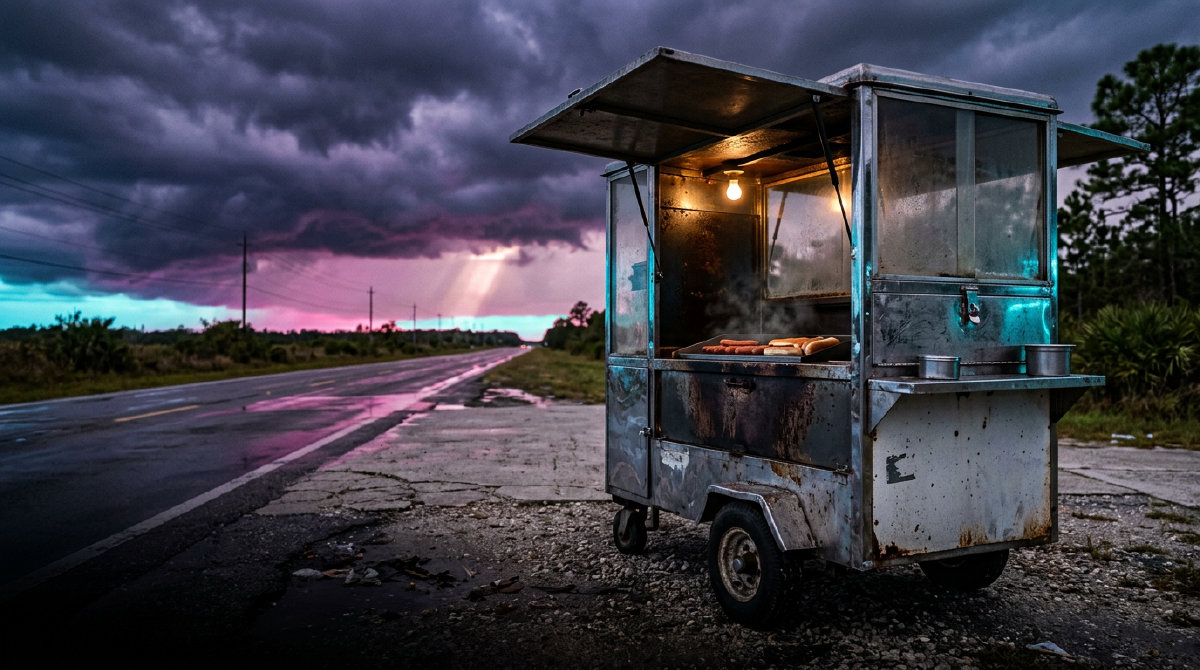
A PC Gamer experiment published on September 25, 2026 reduces that idea to an ordinary action. With a mod, hot dog vendors on the beaches of Los Santos charge $5 for food that restores the character’s health. The interaction recalls GTA 4 and turns a stand that normally helps dress the scenery into a usable service. It is not a mechanical revolution, but this everyday sequence of verbs—approach, pay, eat, and recover—is exactly what makes a city feel less decorative.
Another mod tested by PC Gamer demonstrates the opposite side: systems can also destroy coherence when they do not pull in the same direction. Random Teleport Challenge sends the player to one of 28 points on the map every 50 seconds, making almost any planning impossible. The modification creates deliberately chaotic difficulty, but it also exposes how much GTA’s activities depend on spatial continuity. When the world does not let the player complete an intention, variety stops producing freedom and starts producing interruption.
PC Gamer’s daily series also reveals the cost of stacking changes without central integration. After Dynamic Traffic Colours was installed on a copy already carrying other mods, GTA 5 would only start in windowed mode; switching to fullscreen before loading produced a persistent black screen that required CTRL+ALT+DEL to escape. The mod was meant to diversify vehicle colors, yet many cars retained ordinary shades while others encountered spawning problems. That does not diminish the creators’ work; it simply shows that adding an idea is different from making it coexist reliably with dozens of others.
The barrier is much lower in the visual realm. As highlighted by Eurogamer, YouTuber CityEd imagined London as a GTA city, renaming the capital Trafalgar, Kings Cross as Dukes Cross, and Angel as Saint. The map combines series-inspired cartography, exaggerated landmarks, and names connected to the history or culture of each location. CityEd is not building a game in development, but the project demonstrates that fans already understand and can reproduce Rockstar’s visual and satirical grammar.
GTA 6’s collectibles reinforce this separation between recognizable symbols and systems that are difficult to copy. On September 24, Eurogamer reported that the limited Goodtime State Vice City collection cost £349, excluded the game, and included objects such as a magnetic mirror, keychain, mixing spoon, and small crocodile statue. IGN separately highlighted a $400 offering featuring the alligator mascot Macca and reported that fans quickly produced a 3D-printable model of the figure. The object can be recreated outside the package; what cannot be printed is the network of rules that makes a virtual city react.
Even Xbox’s statement about preorders helps define the size of the challenge, although it says nothing about the quality of the design. Xbox CSO Matthew Ball said the platform’s share of reservations matched its share of the console market and that GTA 6 was already breaking records in the Xbox ecosystem, according to IGN. He provided no absolute figures, so the statement establishes satisfaction and internal performance rather than the exact scale of demand. Still, it shows that an audience is ready to recognize the brand before it can evaluate the full integration of its systems.
The reading
Together, these cases form a kind of ladder of creative difficulty. Renaming neighborhoods with a joke, drawing a map, or modeling a mascot requires talent, but each result can exist as an isolated piece. Enabling a hot dog purchase already requires scenery, money, animation, and health to connect; keeping that interaction stable alongside traffic, missions, and other systems is a much larger problem. It is at this final level, not merely in Leonida’s visual fidelity, that GTA 6 can preserve the advantage of a production centrally built by Rockstar.
This also changes how fan activity can be understood. CityEd’s map, the printable Macca, and the mods are not substitutes for GTA 6; they are unintentional demonstrations of which parts of the formula can be separated and rebuilt. Fans have already mastered many of the series’ nouns: satirical cities, mascots, vehicles, stands, and cultural references. The expectation placed on Rockstar concerns the verbs and the consequences that emerge when all those nouns inhabit the same world.
The counterargument
The strongest argument against this reading is that aesthetics and systems cannot be divided so neatly. Fictional names, satire, cartography, and promotional objects also create the voice that makes GTA immediately recognizable, while a deep collection of mechanics without that voice could feel like another game. PC Gamer also installed mods daily with the stated goal of pushing GTA 5 to its limits, so the resulting instability does not represent normal play or prove what most fans value. IGN’s San Andreas retrospective is an editorial assessment as well, not a Rockstar declaration about its design criteria for GTA 6.
What to watch
The most useful signal going forward will be the presentation of ordinary interactions that cross several systems at once. It will not be enough to show that a shop, stand, vehicle, or animal exists; it will be more revealing to see whether those elements accept actions, consume resources, provoke responses, and remain coherent during other activities. Official demonstrations of continuity among exploration, economy, movement, and world reactions would strengthen this thesis. If GTA 6 relies mostly on recognizable scenery and isolated moments without those verifiable connections, the importance assigned here to its verbs will have been overstated.
Closing
Fans have already proved that GTA’s surface is powerful enough to travel through imaginary maps, printable files, and modified installations. The territory that remains harder to reproduce is the invisible choreography that lets one simple action coexist with every other one. For GTA 6, the decisive leap will not merely be offering more things to see, but giving players more consistent reasons to touch them.
Related
GTA 6 turns density into a production strategy
GTA 6 stopped pursuing two Americas, inherited systems from Red Dead Redemption 2, and gained a structure dedicated to NPCs. Read together, these facts suggest Rockstar moved its ambition from geographic reach to world density.
The final stretch is shaping GTA 6's public history
GTA 6 is not being defined solely by Rockstar's marketing campaign. An earnings call, a labor case, PC expectations and the exploitation of leaks are already shaping the story that will accompany the game.
GTA Splits Play Freedom From Reveal Control
GTA 5 keeps growing as players transform Los Santos, while attention around GTA 6 gives financial value to any unauthorized access. Together, mods, leaks, internal pressure, and even a rare poster reveal two very different relationships between Rockstar and its community.