
GTA 6 Is Using Weather to Define Leonida
Without Orlando or Disney World, environmental simulation takes on the job of representing a condensed Florida.
Redação G6 World
GTA 6 appears to be trading a tourist reproduction of Florida for a condensed version defined by environmental behavior. The exclusion of Orlando and its theme parks becomes more meaningful when placed beside localized storms, dynamic clouds, and effects that remain after the rain. Our reading is that weather will not be mere decoration in Leonida: it will help connect selected regions and sell the idea of an entire state.
The facts
Rockstar has ruled out a parody of Walt Disney World, as well as direct representations of SeaWorld and the Space Coast. According to GameSpot, the confirmation came in a response from Jack McPherson to Game Informer, which had asked whether Central Florida and Orlando attractions would appear in the game. McPherson said those locations would not be present, although he stated that GTA 6 would deliver the “full Florida experience” in other ways. That establishes an important difference between covering the entire real territory and trying to convey its identity.
The explanation attributed to McPherson also shows that the omission was not presented as a simple oversight. The team has to evaluate landscapes, cities, structures, landmarks, views, plant species, and rock formations before design and narrative narrow the options, according to the account relayed by GameSpot. In other words, Leonida depends on selection and compression like any GTA map, but Rockstar is publicly acknowledging that not every famous symbol survives that process. The promise of a “full” experience will therefore have to be fulfilled through the relationships between chosen places, not through the number of recognizable destinations.
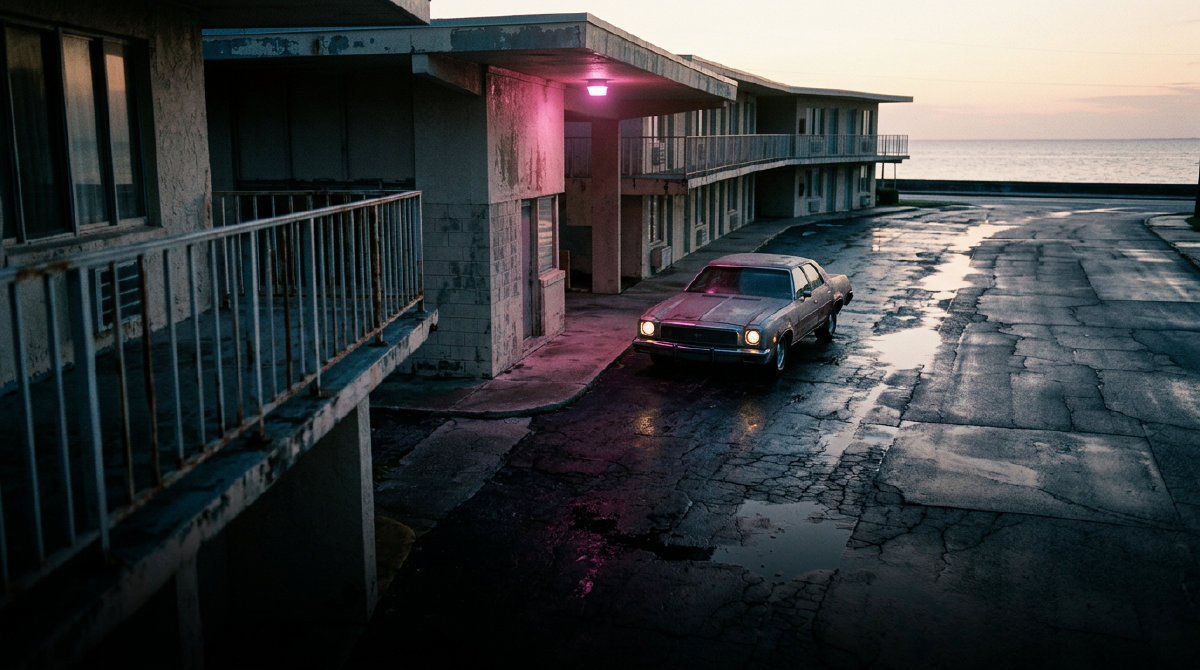
This is where the weather confirmation gains weight. Owen Shepherd, Rockstar’s vice president of art for lighting and rendering, said GTA 6 features a rebuilt weather system that is “much more localized and persistent.” As reported by IGN, new fully dynamic cloud formations can move across the map, allowing rain in one region while a nearby area remains sunny. Simulated tropical storms and hurricanes therefore become part of Leonida’s identity in motion.
Persistence matters as much as the scale of those storms. The supplied information says rain will leave wet areas and puddles behind after it passes instead of vanishing without a trace as soon as the sky changes. It also says weather systems can advance across the map, indicating conditions with their own location and movement rather than a filter applied to the entire world. The source does not detail damage, flooding, mission changes, or effects on traffic, so there is not yet a basis for assigning those consequences to the system.
An IGN retrospective on GTA San Andreas offers a useful benchmark for interpreting these decisions. The outlet argues that one of the 2004 game’s greatest achievements was its density of systems rather than the raw size of its map, even though its fictional state contained three major cities. San Andreas arrived only two years after Vice City and finished 2004 as that year’s best-selling game, according to the retrospective. The comparison does not prove how GTA 6 will work, but it is a reminder that the series’ sense of scale has historically depended on what players can notice and do, not only on how many locations are included.
The reading
Taken together, these facts point to a clear division of priorities. GTA 6 will not summarize Florida by collecting every attraction a visitor might put on an itinerary; it may instead summarize the state through environmental contrasts that follow the player across the journey. Strong sunlight on one side, rain on the other, clouds crossing the horizon, and water left on the ground can make a trip feel distinct even when the map removes entire real-world regions. Weather becomes a kind of temporary geography, redrawing the perception of Leonida without requiring another park, city, or monument.
This strategy could also explain how Rockstar can promise a broad experience after confirming such recognizable absences. A Disney World parody would be one specific location: memorable, satirical, and probably concentrated in a single section of the map. A localized weather system can reach beaches, roads, urban areas, wetlands, and other landscapes considered during the environmental selection process, changing the relationship between them. If it works as described, the investment will create not just another place to visit but a shared condition capable of giving many places coherence.
There is also an editorial consequence for GTA’s satire. Removing Orlando means giving up an obvious target from Florida’s tourism culture, but it does not necessarily mean abandoning commentary on the state. Environmental instability itself could organize situations, contrasts, and behavior across Leonida, although the sources do not yet reveal how the story, missions, or population will respond to it. The point is not that a hurricane replaces a joke about theme parks, but that regional identity can be built through more than one layer.
The strongest counterargument
The strongest counterargument is that we may be assigning too much shared intent to two decisions that could have separate causes. Orlando and its parks may have been removed because of scope, narrative needs, or production priorities, while dynamic weather could remain primarily visual. Persistent puddles and localized rain do not guarantee better activities, distinct regions, or meaningful consequences for the player. The phrase “full Florida experience” is also broad, and the supplied sources do not show which concrete elements will compensate for the confirmed omissions.
What to watch
The decisive signal will be an uninterrupted demonstration of the same location before, during, and after a storm. If future presentations show clouds arriving from another region, rain confined to one part of the landscape, and environmental effects continuing to influence travel, the case for weather structuring Leonida will grow stronger. It would gain further support if Rockstar connects those conditions to specific landscapes, systems, or design decisions. Uniform weather, brief transitions, and purely cosmetic residue would instead suggest that the game’s Florida synthesis depends on elements that have not yet been presented.
Leonida does not need to contain every Florida icon to feel like a convincing interpretation of the state, but it must turn its choices into a recognizable identity. The absence of Disney World establishes the limit of that representation, while the weather system offers one possible way to work across that limit without pretending it does not exist. If GTA 6 can make players recognize Leonida through a changing sky, the distance between sunshine and a storm, and the marks left along the road, the map’s biggest attraction may be the environment itself in motion.
Related

GTA 6 turns density into a production strategy
GTA 6 stopped pursuing two Americas, inherited systems from Red Dead Redemption 2, and gained a structure dedicated to NPCs. Read together, these facts suggest Rockstar moved its ambition from geographic reach to world density.
The final stretch is shaping GTA 6's public history
GTA 6 is not being defined solely by Rockstar's marketing campaign. An earnings call, a labor case, PC expectations and the exploitation of leaks are already shaping the story that will accompany the game.

GTA Splits Play Freedom From Reveal Control
GTA 5 keeps growing as players transform Los Santos, while attention around GTA 6 gives financial value to any unauthorized access. Together, mods, leaks, internal pressure, and even a rare poster reveal two very different relationships between Rockstar and its community.