
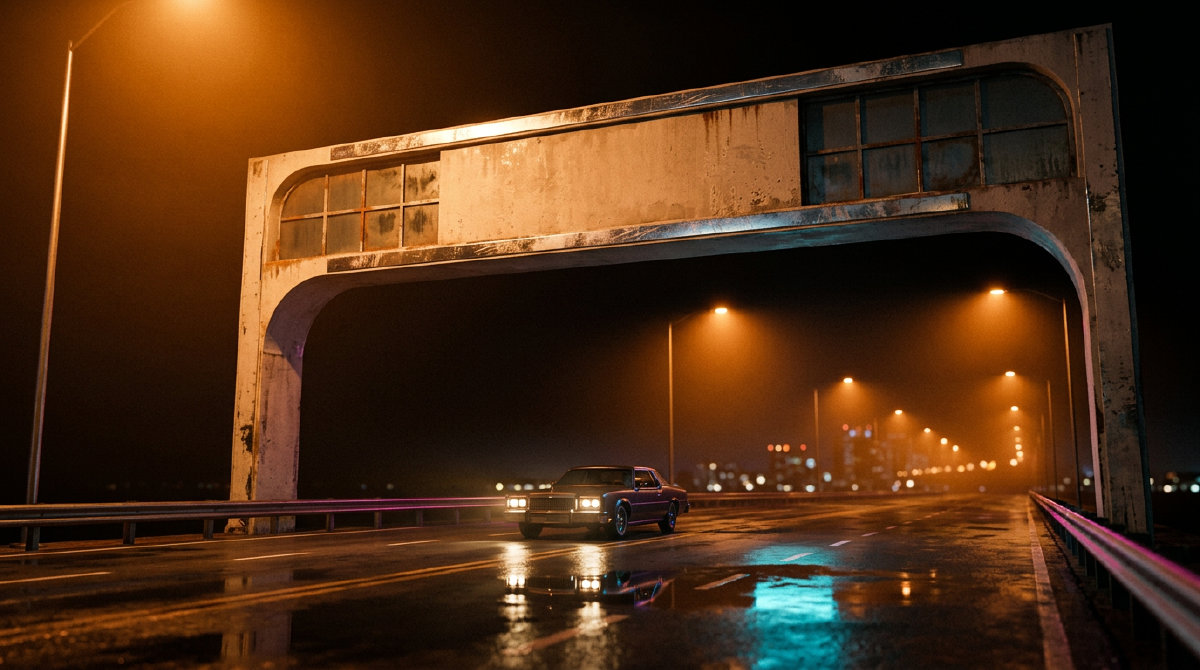
GTA 6 turns Miami into an extension of Vice City
An arena, an album, and the public calendar are bringing the real city closer to the fictional setting before launch.
Redação G6 World
The GTA 6 campaign is doing more than reminding the public that Vice City was inspired by Miami. It is beginning to overlay the fictional city onto the real one, using urban space, music, and even work calendars to make the release feel like an arrival at a destination. Read together, the latest moves suggest Rockstar may introduce Leonida as a cultural experience before revealing it as a fully knowable territory.
The most literal example is at the Kaseya Center, where gigantic GTA 6 letters are being carried by helicopter to form the phrase “Welcome to Vice City.” According to GameSpot, the installation is part of a campaign valued at nearly $1 million, although the source does not provide a completion date. This is not merely advertising placed in Miami: it is the name of a fictional city physically occupying a recognizable site in the city that inspired it.
The chosen phrase makes the operation more meaningful than a conventional billboard. “Welcome to Vice City” works like an entry sign, but it has been installed outside the game and before the public can cross that border digitally. By turning a Miami arena into the support for this message, the campaign reverses the usual relationship: Miami is no longer just raw material for GTA, because it now represents Vice City in the real world.
The original soundtrack adds a second layer to this geographical connection. According to Eurogamer, Grand Theft Auto 6: The Album will contain 34 songs produced for the game, six of which were revealed on September 17; the other 28 remain identified only by their track numbers. The complete album arrives on November 19 alongside GTA 6, making music one of the official routes into Leonida.
The music project will not be confined to the game or digital platforms. Eurogamer reports that CD and vinyl editions will be sold, starting at $20 for the CD and $50 for the standard vinyl, alongside other physical options mentioned by the outlet. When a fictional setting receives a record that can sit on a real shelf, its identity begins circulating independently from the console.
At the same time, the community continues trying to determine how far this geography extends. Eurogamer reported renewed discussion about a possible version of Key West in Leonida, prompted by the circulation of alleged material whose authenticity remains uncertain. Rockstar has not confirmed whether the location was included, adapted, or removed, so none of those possibilities can be treated as a description of the final map.
The significance of that rumor does not come from what the alleged material might reveal, but from the kind of question fans are asking. Key West occupies a distinctive position in the real geography of South Florida, and its possible presence has become an informal measure of Leonida's reach. While the campaign offers a safe point of entry through Miami and Vice City, the audience is trying to discover where the edges of that representation end.
The release calendar indicates that the desire to visit Leonida is already producing effects beyond advertising. Data from BambooHR, a company serving more than 30,000 businesses, shows that paid time-off requests in the United States for November 19 are between 9% and 17% above the historical averages used for comparison. The company does not definitively attribute the increase to GTA 6, but its coincidence with the Thursday launch on PlayStation 5 and Xbox Series X|S provides a concrete sign of mobilization.
Together, these facts form a coherent sequence. The Kaseya Center provides a physical landmark, the album prepares a sonic identity, the Key West discussion projects a desired geography, and the leave requests reserve time for the virtual journey. GTA 6 has not opened Leonida to the public yet, but parts of real life are already being organized as if a destination were about to be inaugurated.
The strongest argument against this reading is that every element can be explained as standard practice for a major entertainment launch. An expensive arena installation is advertising, a physical album is licensed merchandise, map rumors are routine in fan communities, and BambooHR did not prove that GTA 6 caused the increase in leave requests. It is also possible that the deeper relationship with Miami will end with this specific activation rather than become the campaign's dominant language.
The next signal to watch is repetition. If new activations occupy recognizable Florida locations, if the remaining 28 songs are presented as parts of Leonida's identity, and if official material clarifies how real geography has been reinterpreted, the thesis will grow stronger. If the campaign returns to generic advertising without territorial continuity, and the final map reduces the connection to superficial references, the Kaseya Center installation will have been an isolated spectacle.
For now, the most revealing image is a Miami arena receiving a greeting from Vice City by helicopter. Rockstar is still carefully controlling what the public knows about Leonida, but it is already allowing the fictional city to cross the screen and claim space in the real landscape. The game's challenge will be making that entrance feel just as convincing when the destination finally opens on November 19.
Related
In GTA 6, the Map Will Matter Through the Journey
The Key West debate measures GTA 6 in miles, but an airport mod and Rockstar’s music promises suggest another metric: the quality of the journey.
New rules may push GTA mods toward systems
By restricting expansions of its official continuity, Rockstar may change the creative center of GTA modding. Experiments with airports and credit show how everyday systems could gain prominence without trying to rewrite the story.
GTA 6 turns single-player into a collective event
GTA 6 will arrive without a new multiplayer experience, yet its campaign is already affecting work calendars and mobilizing music and streaming platforms. The signs suggest Rockstar does not need to put everyone on the same server to turn single-player into a collective event.