
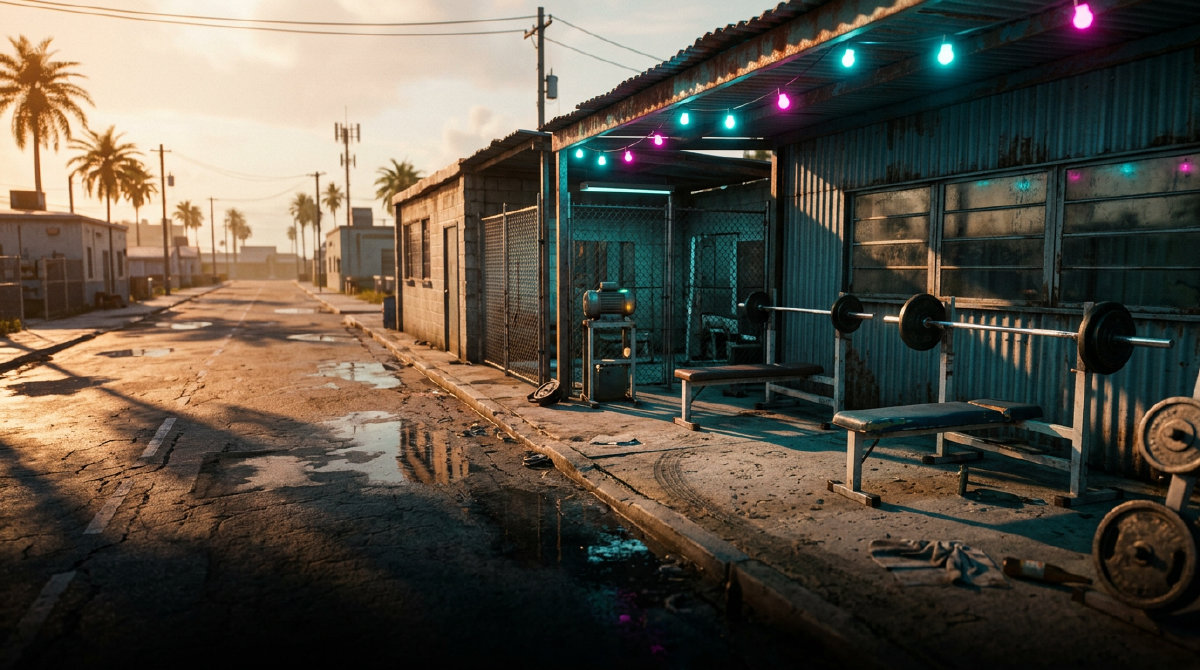
GTA VI splits identity between biography and routine
Dre'Quan arrives with a defined profession, while Jason and Lucia will be shaped by the player's habits.
Redação G6 World
GTA VI appears to be building identity in two different ways: Rockstar defines who the supporting characters are, while the player helps determine what Jason and Lucia become. Dre'Quan Priest arrives with an established profession and social position, but the protagonists will have bodies marked by food, exercise, and lack of rest. That difference suggests a deliberate split between written biography and played routine.
The facts
The official GTA VI website introduces Dre'Quan Priest as a music producer and member of the supporting cast. This confirmation did not originate in a rumor or leaked material, and Rockstar does not identify him as a playable protagonist. For now, the most concrete fact about him is not a combat skill or criminal connection, but the occupation he holds in Leonida.
The distinction becomes more meaningful when Dre'Quan is placed alongside Real Dimez. Rockstar identifies Real Dimez as a musical duo, while assigning the producer role to Dre'Quan. Even within the same broad field, the names have not been grouped under a generic label: each holds a different position in the officially presented music environment.
Jason Duval and Lucia Caminos receive another kind of definition. According to an August 27 Eurogamer report based on Dazed's preview interview with Rockstar, food can affect the weight of both protagonists. Exercise will also visibly develop and tone their muscles, allowing their appearance to record choices sustained during play.
The same account says that going for long periods without sleep can leave marks on Jason and Lucia's faces. Dazed connected this reaction to circumstances such as remaining on the run from the police or spending several days caught in a cycle of excess. This would therefore be more than an initial appearance selection: at least part of the protagonists' visual condition will respond to the routine created by the player.
A preview covered by PC Gamer adds vehicles to this pattern of routine. According to YouTuber TGG, filling a combustion car or charging an electric vehicle triggers a scene lasting about ten seconds, while stations would also offer repairs. Rockstar's Rob Nelson reportedly described the process as quick and asked how the public might respond to the mechanic, indicating that its time cost was discussed during the presentation.
Driving, meanwhile, was described by GamesRadar+ as combining the best aspects of GTA IV with the accessibility of GTA V. The available material does not identify the Rockstar executive behind the statement or explain which concrete elements of either game have been retained. Even so, the wording points to a stated concern with balancing physical sensation and ease of control, rather than simply pursuing the highest possible level of simulation.
The reading
Taken together, these facts reveal two scales of characterization. Dre'Quan and Real Dimez are defined through the places they occupy in a social and professional network already written by Rockstar. Jason and Lucia, by contrast, arrive as authored characters but receive another layer through the player's repetitions: eating, training, resting, fleeing, and moving through periods of excess.
This could make the protagonists' identities less dependent on menus and more connected to the continuity of a playthrough. If their bodies genuinely retain signs of routine, the Lucia or Jason seen after several days on the run may not look like one maintained through rest and exercise. The important difference is not merely cosmetic; it is the game acknowledging that something was lived between one mission and the next.
The vehicles described in the preview reinforce that reading on a smaller scale. Fueling, charging, and repairing turn a car into something that may require continued attention, while the stated handling approach attempts to preserve accessibility. This parallel does not prove that people and vehicles belong to connected systems, but it does reveal a shared language: central parts of the experience carry signs or costs from the way they are used.
That combination also explains why Dre'Quan's profession matters even before a mission or mechanic has been detailed. A music producer is not merely a name on a list; it is a role that implies artists, work, and relationships within the setting, although Rockstar has not explained how those elements will appear in play. While the protagonists accumulate a bodily history created during the playthrough, supporting characters can give Leonida a social history that existed before the player arrived.
The strongest counterargument
The strongest objection is that we are connecting details that may remain separate in the finished product. Dre'Quan's occupation could function only as narrative presentation, while weight, muscle, and fatigue may result in limited visual changes without deeper consequences. The ten-second fueling sequence could also be an isolated interaction, and the comparison between GTA IV and GTA V is too vague to confirm an overarching design philosophy.
What to watch
The decisive signal will be the persistence of these details during play. The thesis becomes stronger if future demonstrations show accumulated habits remaining visible, vehicle care changing the player's relationship with a car, and Dre'Quan's occupation organizing meetings, missions, or connections with other musicians. It becomes weaker if the alterations are quickly reversible, if stations operate as isolated animations, and if supporting characters' professions exist only in promotional biographies.
GTA has always introduced memorable characters, but GTA VI may be separating more clearly what the author provides from what the playthrough adds. Rockstar writes Dre'Quan as a producer and positions Real Dimez as performers; the player, in turn, may leave Jason and Lucia exhausted, strong, or visibly changed by their habits. If that structure survives into the complete game, Leonida will be defined not only by who lives there, but by the marks that living there leaves behind.
Related
GTA 6 could turn one launch into two peaks
The Twitch chief’s multiplayer forecast and the campaign linked to Spotify point to an important possibility: GTA 6 could occupy the calendar through two launch moments rather than one.
GTA preserves its past in two different ways
GTA: London 1961 returning to the headlines and ambitious GTA 5 mods reveal two different ways of keeping the series’ history in circulation.

GTA 6 Must Mark Where the Puzzle Ends
The collective search for clues is part of the anticipation for GTA 6, but artist posts, casting speculation, fabricated reviews, and drones show that not everything around the game is a puzzle piece offered to the public.